Confirmation Bias Definition
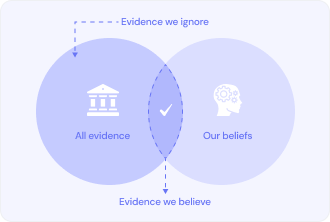
Confirmation bias – dеscribes our deep-seated tendency to notice, focus on, and give more credence to evidence that is consistent with our existing beliefs. Using аppropriate research methods, confirmation bias can be recognized and avoided in UX design.
For example, confirmation bias can occur unintentionally when writing an article. If you only click on information that is consistent with your thesis and ignore contrary (possibly factual) information, you are demonstrating confirmation bias. This hinders the expansion of your knowledge as well as that of your readers.
Manifestation of confirmation bias in UX design
Confirmation bias manifests in plenty of ways that directly undermine human-centred design:
- Selective attention. The designer only sees aspects of user feedback that support their design concept and overlooks the critical parts.
- Biased interpretations. Usability tests are conducted to either give validity to or contradict a design thinking and perspective, rather than providing learning opportunities.
- Selective recall. Focusing on reinforcing the positive experience and ignoring the negative comments leads to raising other biases as well.
Again, these behaviors operate mostly without the designer’s conscious knowledge, which makes confirmation bias very perilous when it comes to design work; here, it is the very subjectivity of the design that jeopardizes any effective experience for users.
Impact on the design outcomes
The concept of confirmation bias in UX not only affects individual errors but also erodes the very essence of the user-centered design philosophy. When designers look for confirmation instead of the truth, they usually overlook the real needs of users and solve the problems that exist in their own minds only.
So, the team’s resources are spent on adding new features that customers might not appreciate, and the accessibility problems are widely neglected as the team members do not suffer the consequence personally.
The team ships an interface that makes perfect sense to the design team but leaves the actual users confused. In the end, user satisfaction is lower, support costs are higher, and the products are not successful.
Practical strategies to avoid confirmation bias
To protect the design process from confirmation bias, developers must:
- Explore real viewpoints of the user by using other forms of research before beginning to come up with a solution.
- User is first, the team’s opinion is second.
- Make clear all the assumptions before user research.
- Analyze negative feedback before celebrating positive comments.
Although they might not totally wipe away the partiality, these methods indeed boost the accuracy of UX evidence, which eventuates in products being designed from the real users’ standpoint rather than the designers’, securing user satisfaction.