Retail Software Development: Complete Guide

Since countless companies are going online and need technological support to stay ahead in the game, custom retail software development is being talked about more than ever. Our overview will highlight the main specifics of this high-tech backbone, making the entire process transparent to you.
You will gain valuable insights into how to build retail software and what crucial points are always worth taking into consideration. Limeup provides retail software development services, so if you are willing to strengthen your business with our top-notch support to increase revenue, just contact us, and we will discuss your project right away.
What is retail software?
This notion refers to all digital custom retail software development solutions created for the purposes of managing, facilitating and optimizing a range of operations within consumer goods businesses. They act as the lifeblood of the modern commerce enterprise, without which it cannot efficiently run. This is just like a perfectly orchestrated symphony that brings harmony to sales processes, inventory management, customer interactions and financial transactions.
Most retail software development companies today provide cloud-based options, allowing firms to maintain a real-time data feed and seamless operations spanning multiple locations. Often presented as a bridge, these configurations integrate specific platforms, enabling a unified coordination approach to both online and offline sales channels.
Therefore, intrinsically, it harmonizes diverse corporate activities to offer a smooth and engaging interaction. Options in retail & eCommerce software development can range from Point of Sale (POS) systems that keep transactions flowing without roadblocks at checkout counters to inventory management structures that are a safety net, preventing stockouts and automating reordering processes.
As the world of merchandising marches toward digital transformation, such technological support becomes a secret weapon to give firms the upper hand, adjust to rising consumer expectations and respond to competitive pressure at the drop of a hat.

How to build retail software in 5 steps?
Creating direct selling applications is not an easy task, it necessitates a strategic approach so that the final result touches all the possible bases — from enterprise priorities to customer experience improvements and operational efficiencies. Below is a five-phase process to develop an effective sales solution without reinventing the wheel:

— Step 1. Define requirements and goals
Industry essentials, user profiles and core functionalities come first — a place where theory meets practice — then decide whether the program will provide inventory management, customer relationship management (CRM), point-of-sale (POS) systems, eCommerce integration, or analytics functions.
Lastly, market research should be completed similar to these insights and feedback solicited from stakeholders to ensure the desired features correspond to actual business needs and are not way off the mark.
— Step 2. Choose the right technology stack
The choice of a toolset should depend on the user requirements for scalability, performance and security. In terms of web-based retail apps, the most common choices would be those like React, Angular, or Vue.js for the front-end and Node.js or Python (Django) or Ruby on Rails for the back-end.
A retail software developer applying Flutter or React Native can integrate mobile applications for cross-platform scenarios. Database selection would depend on complexity; some of the options could include PostgreSQL, MongoDB, or Firebase.
— Step 3. Create a minimum viable product (MVP)
Thus, some will start with an MVP application, one that would have the core functionalities like keeping an eye on inventory, payment processing and user authentication — after all, that would be putting the horse before the cart.
Software development for retail here will include UI/UX designing, API integration and back-end developing while maintaining agility to go through the punches. Implement cloud-based solutions like AWS or Google Cloud to ensure flexibility and reliability so your software doesn’t crumble like a house of cards when demand surges.
— Step 4. Test and optimize
Consider it of paramount importance to examine everything beyond usefulness, safety and user-friendliness — outright skipping this step is akin to building a house upon sand. So, we must go through unit and integration validation and user acceptance testing (UAT) to dig out bugs before they dig into you.
Load checking is another aspect to investigate whether the system will stand at its peak transactions or crumble under pressure and security audits guard personal customer data and information regarding financial transfers from being hacked.
— Step 5. Deploy and scale
Upon the successful completion of the previous step, the project should be deployed through CI/CD pipelines to facilitate easy updates — because no one wants to be caught flat-footed with outdated tech. Stay in the loop, tracking performance with analytics tools such as Google Analytics or New Relic.
As the business grows, don’t rest on your laurels — integrate advanced functionalities such as AI-driven recommendations, personalized promotions and omnichannel support for an irresistible customer retention recipe using retail software development services.
By following these five phases, you can develop a rock-solid ecosystem that runs like a well-oiled machine, improves efficiency, enhances consumer satisfaction and drives revenue increase — because, at the end of the day, a smooth shopping journey keeps everyone coming back for more.
Key features of custom retail software development
With the digital world moving at such a rapid pace, staying ahead is not just dependent on a good product; it is also having a technological backbone that acts as a nicely calibrated engine so that every component clicks in simultaneously. From fine-tuning operational processes, businesses must now embrace innovative solutions that guarantee efficiency, precision and agility in a rapidly changing marketplace.
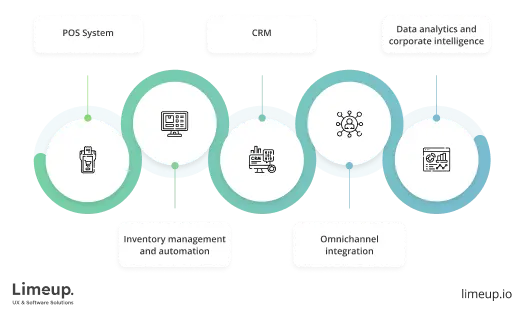
- POS System
A perfect and intelligent POS system is the cornerstone of shopkeeping nowadays, let alone processing transactions, real-time inventory and payment gateway integration, as it holds everything together. This advanced option not only does that — it works simultaneously online and offline, making sales possible even without connectivity problems. That is the kind of reliability that keeps up with today’s busy world while making sure customers never face a jam.
- Inventory management and automation
In custom software development for the retail industry, stock control can be said to be the lifeblood of the endeavour; indeed, here is where automation in item tracking lifts the burden off the shoulders of shop floor staff. Manual error checks reduce overstocking or stockouts and by using AI-powered analytics to predict demand, this system foresees everything.
- Customer relation management (CRM)
The secret ingredient that allows retailers to keep track of user interactions and personalize marketing campaigns and loyalty programs to keep buyers coming back is a powerful CRM system. AI-powered insights are the crystal ball into client preferences from which you can draw the right conclusions to provide them with highly bespoke recommendations, thus increasing sales and engagement and turning first-time customers into avid fans.
- Omnichannel integration
Modern people want an uninterrupted shopping experience on multiple platforms, be it at a brick-and-mortar store, through an eCommerce website, or scrolling a mobile app — it is a question of convenience. Custom retail software serves as the glue, tying it all together and unifying these channels for price integrity, real-time inventory synchronization and a unified brand perception, keeping end users engaged every step of the way.
- Data analytics and corporate intelligence
Retailers, burdened by the challenges of data-driven decision-making akin to relying on a map during a trip, navigate their path toward profitability. Personalized retail software development solutions, in this case, offer real-time dashboards, sales trend analysis and purchaser behavior insights. Firms can thus tune marketing strategies, revise pricing models in real time, and manage inventory, keeping them ahead of the curve with the wealth this data offers.
How much do retail software development services cost?
In a nutshell, this programming process does not arrive at an estimate for the work through some linear function of the value of the project and local billing rates to hire software developers — it indeed has many variables. Customization level, third-party integrations, security requirements, compliance with the industry, maintenance after launch — all come into play when putting together the final billable expense.
Much like the tailoring of a custom suit, the more elaborate the details, the heavier the investment, but the upside is a product that fits the business like a glove.
These highly customized solutions integrate seamlessly with ERP systems, supply chain management tools, or AI-driven personalization engines — hence the greater development fee: precision work is expensive. Additionally, investments are added for heavy-security features, such as PCI DSS to ensure guarded payment processing or GDPR to guarantee airtight data protection.

Just not a convenient extra, scalability is among the most basic conditions for long-term success. An expanding user base, additional locations, or skyrocketing transaction volume are all cost-driving factors. Retail software developers need to meticulously fine-tune the architecture engine like a high-performance one, which obviously adds time and software development costs.
On top of that, cloud-based options come with their ongoing price tag, including cloud hosting, API usage fees and database management fees. It’s a balancing act — investing upfront in a scalable system affirms the project won’t buckle under future growth.
| Project scale | Estimated cost | Features included | Hourly rate by region |
| Basic retail software | $20,000 – $50,000 | Basic POS system, inventory tracking, sales reports. | NA/EU: $100-$150, EU East: $60-$100, Asia/LatAm: $20-$60. |
| Mid-sized solution | $50,000 – $150,000 | Omnichannel sales, CRM, loyalty programs, multi-store management. | NA/EU: $120-$180, EU East: $80-$120, Asia/LatAm: $40-$80. |
| Enterprise-grade option | $150,000+ | Custom ERP, AI-driven insights, real-time inventory sync, cloud infrastructure | NA/EU: $150-$200, EU East: $80-$120 Asia/LatAm: $60-$100. |
In the end, after deployment time, support and updates are what would make a software with its long-term fortune in terms of life — even the most advanced retail creation might indeed become outdated in this fast-paced mode. Shopkeepers call for the continuity of maintenance, feature enhancement and optimization of performance to keep up with the dynamics in which customer demands and industry changes are taking place.
Every retail software development services provider has support plans that range between $5,000 and $20,000 from one year to another, depending on the level of agreements (SLAs) attached. It’s like maintaining a high-performance vehicle — regular tune-ups ensure smooth operation and prevent costly breakdowns down the road.
How to select a company to create custom retail software?
Today, amid rapid digital changes, being successful and profitable for your business implies much more than just intuition and experience; It means a good understanding of technology trends, consumer expectations and market dynamics. To be able to integrate innovations into a retail ecosystem could very well spell out the difference between success and failure.
Choosing the right programming partner becomes that critical decision that sets the foundation for future growth as firms race to greater efficiencies, customer engagement and operational agility.
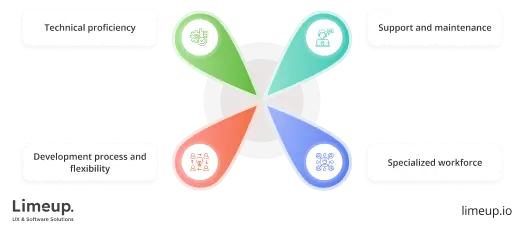
- Technical proficiency
Thus, the custom retail software development services vendor needs to be good in technology, such as cloud infrastructure, AI analytics, and seamless integrations of a POS system. Without this, it’s going to be shaky ground on which you might be building. Their expertise in current frameworks, databases, and security protocols will ensure your software scales under all conditions rather than collapse with the loads.
- Development process and flexibility
Choosing a structured yet adaptable way of working, one that is Agile or DevOps, will allow a smooth transition in the platform creation process. This ensures that companies can incorporate feedback while adapting to changing requirements and rolling out enhancements in perfectly synchronized moves while looking for a specific retail software development service.
On the other hand, a rigid approach may well be compared to getting a ship to steer with its anchor down — stifling innovation and progress. Being modifiable is the only way to sustain success and stay ahead in the digital world and support long-lasting income.
- Support and maintenance
A styled sales places isn’t a set it and forget it affair — it needs frequent updates and bug fixes to keep pace with the ever-changing needs and trends of the day.
After all, working with a company that offers retail product development software with quality post-launch support, periodic maintenance and instantaneous troubleshooting will affirm that minor hiccups will not snowball into major roadblocks because, in the rapid retail world, downtime equals money down the drain.
- Specialized workforce
Choose a dedicated development team that possesses an in-depth knowledge of your industry, integrates effortlessly with your existing systems and has proven capabilities in omnichannel commerce. They should communicate clearly, scale easily and have a long-term partnership outlook because an enduring partnership today will help avert headaches tomorrow.
Points to sum up
In this guide, we flesh out the essentials of costs that have been key features in this type of programming, describe the stepwise procedure for building such platforms and refer to the critical aspects for choosing a proper retail software development company. This significant knowledge is more like treasure in a well-drawn map towards an undefined fortune and it helps you navigate through the underbelly of technologies for the right decisions that spur success.
The deeper you know these factors, the more businesses can optimize their budgeting and confirm that their app aligns with their operational requirements for higher efficiency and customer satisfaction. Choosing the right technology is much more than a monetary decision since it can strategically tip the competitive scale for entrepreneurs in an ever-changing world.
Join our forces to design next-generation retail solutions that would bring out the maximum potential and would prove competent enough to drive innovations and keep on being at the head of the race. Сontact Limeup, and with our skills and expert technical knowledge, you won’t just be able to follow industry tendencies; you will be the trendsetter, staying one step ahead and leaving all competitors in the dust in the world of sales.