Top Programming Languages in the UK in 2026: Market Insights


Choose the right programming languages and you’re positioned for competitive hiring costs, efficient project timelines, and code that’s a joy to maintain and scale. Launching a new product, hiring more engineers, feeling fed up with old tech stack, all these objects are important when selecting an environment.
The UK tech sector is experiencing exciting growth in 2025-2026: AI adoption has surged by 34%, demand for Go developers is up 40%, and Swift developer demand has jumped 28%. This guide shows you what’s actually working for UK businesses right now, based on real market data about current coding languages.
We’ve dug into hiring costs, developer availability, and what’s happening across the UK tech sector. The result is practical insights you can actually use when making decisions about your stack.
Why does choosing the right programming languages matter?
Selecting the right programming language shapes how your business operates. It influences everything from your bottom line to your customers’ experience, so it’s worth getting right from the start.

- Financial performance and efficiency
When you select a language well-suited to your needs, you gain immediate advantages. Python-based data processors, for example, execute efficiently without requiring expensive server infrastructure, like many businesses see thousands in annual savings.
Your team gets stuff done faster too. Features that would take months on other stacks? You’re shipping them in weeks. That means you hit the market first and honestly that’s where the real advantage is getting there before your niche competitors do.
- Reliability and performance
The language you opt for influences how reliably your systems run. Modern languages like Rust used by an experienced software development company prevent entire categories of memory-related issues, keeping applications stable and reducing unexpected downtime.
Java offers proven reliability across enterprises. Meanwhile, a well-chosen backend like Go delivers lightning-fast performance, such as websites loading in milliseconds that can make or break your product. This performance advantage directly translates to user satisfaction and competitive advantage.
- Long-term flexibility and cost control
Making a thoughtful choice now prevents expensive problems later. Think about it: moving from one technology to another is a massive undertaking. It costs time, money, and headaches. That’s why picking a language with solid community backing and current relevance is so important.
The language you choose today shapes your business’s trajectory. Understanding these tradeoffs helps you make a decision that pays dividends for years to come.
Top programming languages in the UK (2026)
Business leaders face critical decisions about technology investment. Should you build with Python for speed and flexibility? Invest in JavaScript to reach every browser? Choose Java or C# for enterprise stability? It is challenging to evaluate every aspect on your own.
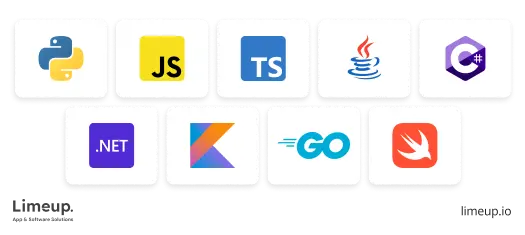
In this part of the article, we cover the seven programming languages dominating UK and global technology in 2026. Each section explains why major businesses choose that language, what problems it solves, and where to find skilled developers. You’ll find verified statistics from industry surveys, job market reports, and platform data.
Python
Python has been the most popular programming language globally for years without slowing down. According to the November 2025 TIOBE Index, Python is sitting at the top with over 23% of the market. What’s wild is how much it’s grown as it jumped 7 percentage points just from 2024 to 2025.
Here is the table with explanation of core Python advantages:
| Aspects | Description |
| AI and Machine learning | Dominates artificial intelligence development with TensorFlow, PyTorch, and scikit-learn |
| Fast prototyping | Build working prototypes in days instead of weeks with existing libraries |
| Data analysis | Industry standard for processing, visualising, and extracting insights from large datasets |
| Cross-platform | Runs on Linux, Windows, and macOS without code changes |
In the UK job market, Python developers are in high demand. Tech startups across London and Manchester rely on it. Even UK government organisations (GCHQ, Cabinet Office) trust Python for critical systems.
JavaScript and TypeScript
According to Stack Overflow’s 2025 Developer Survey, JavaScript is one of the most popular modern programming languages, with 66% of survey respondents reporting that they had used it in the past year. TypeScript adoption in UK companies has grown 45% year-over-year especially among companies modernising their front-end stacks.
Here are the reasons why businesses decide to hire JavaScript developers:
| Aspects | Description |
| Universal browser support | 99% of all websites run JavaScript; no alternative exists |
| Full stack creation | Use one language for front-end and back-end with Node.js |
| Enhanced UI | React, Vue, and Angular frameworks ship features fast |
| Real-time applications | Perfect for chat apps, notifications and live dashboards |
Java
The language powers banking systems, eCommerce platforms and large-scale backend services that millions of users depend on daily. Its stability and performance make it the default choice for mission-critical applications where uptime and reliability matter.
| Aspects | Description |
| Enterprise solidity | Powers financial systems, banking, and mission-critical infrastructure |
| Robust performance | Handles high-traffic systems reliably |
| Better security | Built-in security features required by financial and government sectors |
| Cross-platform | Write once, run anywhere on any operating system without changes |
A Java developer’s experience managing large systems makes them valuable to organizations handling complex backend infrastructure
C# and .NET
Amidst the latest programming languages, C# is now the fastest rising language according to TIOBE Index, with Microsoft backing it as their most supported programming language. C# is built for the .NET framework — and the cool thing is that .NET runs on Windows, Linux, macOS, setting no limits for you to reach different target audiences.
.NET ecosystem has some solid tools built into it. ASP.NET Core is great if you’re crafting web apps and .NET MAUI lets you create mobile apps without switching languages.
C# benefits from the strengths of this ecosystem, so when an organisation decides to hire a .Net developer, they receive support of enterprise software, internal tools, cross-platform apps, game development.
| Aspects | Description |
| Microsoft integration | Native support for Azure, Office 365, and Windows environments |
| Fast scaling up | Highest growth rate among enterprise languages, modernising quickly |
| Cross-platform | Suitable for macOS, Linux, Microsoft |
| Better performance | ASP.NET Core, the fastest web framework in industry benchmarks |
Kotlin
The rise of this most-used programming language matters because it directly impacts mobile app development in UK businesses. Google’s consistent support for Kotlin, including new tools and libraries, has further strengthened its position.
| Aspects | Description |
| Dominance in Android niche | 90% of Android developers use it |
| 30% less code | Fewer lines of code than Java |
| Multiplatform fitability | Share business logic between iOS and Android |
| Better UI/UX | Modern UI framework makes building Android interfaces fast and intuitive |
Companies like Netflix, Uber, and Pinterest use Kotlin for their Android applications so the urge to hire Kotlin developers is growing.
Go
Go has moved from a niche language to a mainstream choice for building cloud infrastructure and backend systems. The TIOBE Index we linked above places Go in the 7th position as of April 2025, representing the highest position ever for this most common coding language.
| Aspects | Description |
| Cloud infrastructure | Powers Docker, Kubernetes, Terraform |
| Simple syntax | Cleaner than other languages and easier to learn |
| Microservices | Perfect for breaking large systems into smaller, independent services |
| No dependencies | Single compiled file runs anywhere; no runtime installation needed |
Swift
Apple’s Swift language dominates iOS app development in the UK and globally. As for the United Kingdom market, according to the website TheirStack, 2.2k firms use this technology. They work with Swift developers that have proficiency in creating apps that scale across iOS, iPadOS, macOS, and visionOS.
| Aspects | Description |
| Revenue opportunities | App Store generates double the revenue of Google Play |
| Running across all Apple devices | Only language supporting iOS, macOS, visionOS, and watchOS |
| Modern language | Designed from scratch |
| Innovative UI | SwiftUI for better usability |
With the knowledge of common programming languages, you are able to make better decisions when deciding the tech stack for your software, app or a website. Further, let’s consider the industries from England and which technologies suit them the best based on our experience of working with related projects.
Coding languages by industry in the UK
Technology choices in your industry aren’t random as they are the result of years of trial and error, budget constraints, and specific regulatory requirements. Simultaneously, a fintech firm choosing Java for payments gains instant access to proven infrastructure. A startup selecting TypeScript ships features twice as fast as competitors.
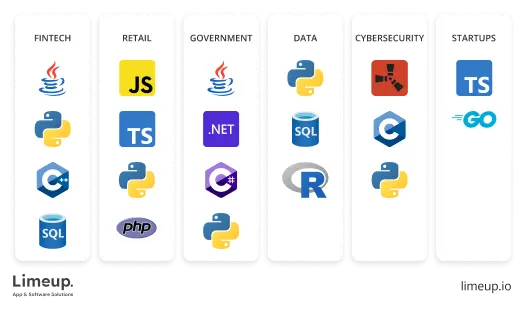
This section shows you the languages that have proven themselves in six major UK industries: fintech, retail, government, data science, cybersecurity, and startups. You will see what’s actually deployed in production systems, why teams chose those languages, and what competitive advantages come from following industry patterns.
Fintech
Considering the common programming languages for this niche, businesses choose technologies that handle massive transaction volumes reliably, meet strict regulatory requirements. For example, contacting an app development company in the UK for Android mobile platform crafting, they have to select Java experts.
Let’s dive into the typical tools used for this area:
- Java: handles billions in daily transactions and has proven security.
- Python: allows fast model development and provides access to excellent data libraries.
- C++: enables extreme performance and algorithmic execution.
- SQL: makes transactions effortless, as well as handling financial record management.
Retail
eCommerce brands face a different challenge: speed and user experience since visitors will not wait for a site to load more than 3–5 seconds. Retailers need the best programming languages that deliver fast websites, handle payment processing, and scale from one user to a million users during sales events. Like the named ones below:
- JavaScript: the best for speed and user experience determines sales conversion.
- TypeScript: suits large, enterprise-grade retail platforms with the need to cope with high traffic.
- Python: enhances inventory management and provides better data analytics.
- PHP: is used for legacy systems across well-established retailers.
Government
Government technology works by different rules since systems must support citizens for decades. Security cannot be compromised in the niche where audits and compliance requirements drive decisions. Procurement processes favour proven, protected solutions.
- Java: primarily suits core government systems that take care of citizen services.
- .NET (C#): is best for the newer products creation with Microsoft-based infrastructure.
- Python: makes automation accessible to government organisations.
Data
Among the programming languages list for this market, that are common for full stack development companies, there is the combination of three tools that allow businesses to benefit the most from the creation:
- Python: is the most dominant ecosystem (especially for AI predictive analytics).
- SQL: suited for data extraction plus analytics queries.
- R: helps with statistical analysis, research computing.
Cybersecurity
Security professionals think about threats differently. Languages must prevent entire categories of attacks. Code must be auditable by security teams. Performance cannot come at the cost of safety. The languages dominating cybersecurity prioritise preventing vulnerabilities over convenience:
- Rust: used for New security-critical systems, vulnerability prevention
- C: is necessary for security tools, kernel-level code.
- Python: is the best for security automation, incident response, threat analysis.
Startups
Startups have to move fast and get to market before capital runs out. They hire small teams of exceptional people. They need stacks that let one person do the work of many. Technology choices that work for startups often fail for large enterprises, so it is essential to stick to:
- TypeScript: is needed for full stack applications, API backends.
- Go: suits for fast deployment, API servers, backend infrastructure, DevOps
We considered the most popular coding languages for different industries, and armed with this information, you are ready to move to the actual steps you need to take to opt for the most suitable tech stack for your needs.
How to choose the best language for your UK project?
Picking the wrong language doesn’t feel like a mistake at first: by week one, you’re building; by month three, you’re fighting performance bottlenecks; by year two, you’re considering a complete rewrite.
That’s why this section not only answers, “What is the best programming language?” but cuts through the noise and our experts will walk you through the four decisions that actually matter for your project.

Scalability needs
Start here: how many users will your system serve, and how much data will it handle?
A weather app serving 50,000 users works fine in almost any language. A banking platform serving millions of transactions daily doesn’t. Scale is not just a technical detail, it’s a language decision and a core point when you need to hire a software developer.
Budget and team availability
The list of programming languages has to be considered for the price as well, so let’s study the curve for annual salaries:
| Language | Mid | Senior | Junior |
| Java | £60,000 – £80,000 | £85,000 – £120,000 | £35,000 – £45,000 |
| Python | £55,000 – £75,000 | £80,000 – £110,000 | £32,000 – £42,000 |
| JavaScript/TypeScript | £55,000 – £80,000 | £85,000 – £130,000 | £30,000 – £40,000 |
| C#/.NET | £60,000 – £85,000 | £90,000 – £125,000 | £35,000 – £48,000 |
| Go | £90,000 – £130,000 | £120,000 – £160,000 | £45,000 – £60,000 |
| Swift | £70,000 – £100,000 | £100,000 – £140,000 | £40,000 – £55,000 |
| Rust | £85,000 – £125,000 | £115,000 – £150,000 | £42,000 – £58,000 |
Speed of delivery
How quickly do you need to launch? The answer will help you with your choice of the best programming language. TypeScript and Python let teams move fastest. Java and C# require more ceremony upfront. You spend weeks setting up proper architecture, configuring frameworks, and establishing patterns, while Go sits in the middle.
Compliance in the UK
What is the most used programming language that can handle financial data, personal information? It depends on the market you operate in, but commonly, there are three points to be taken into account: GDPR, audits, and security track record.
Regulated industries require languages that simplify compliance documentation, like Java’s mature ecosystem and extensive logging frameworks make it the gold standard for financial services.
Here is a simple and useful checklist from our experts that actually works for all industries:
Business goals & performance
 Does the language support your primary use case (web, data, fintech, cybersecurity)? Will it deliver the speed to market you need? Does it reduce infrastructure and hosting costs?
UK talent pool
Is there strong developer availability in the UK market? What are typical salary expectations for specialists? Can you find experienced contractors or agencies if needed?Your Industry best practices
What languages do UK market leaders in your sector use? Are there regulatory preferences for your industry? Does the language align with emerging UK tech trends?With so many tools and environments available, a roadmap becomes a savage for companies seeking the proper tech stack. Follow the key four factors we considered above, and you will be able to make this selection process easier.
Future trends in UK coding landscape
The technology landscape in the UK is shifting rapidly. As a business leader, understanding these changes helps you make smarter decisions about the best coding language your team should invest in learning and which tools will keep your company competitive over the next few years.

AI-driven coding trends
Here’s what’s actually happening in UK development teams right now: AI isn’t replacing programmers but acting like tech partner. A survey by GitHub’s 2024 State of Software Development found that 71% of UK developers use AI tools because when they hit a tricky problem AI handles the repetitive stuff so your team focuses on what matters.
What does this mean for your business? Investing in Python expertise now positions your company to adopt AI tools and capabilities quickly. Companies that build AI competency early gain a genuine competitive advantage in their market. You’re not just learning a language; you’re building capacity for the next generation of business solutions.
Rising adoption of Go and TypeScript
Go is among top coding languages that appeal to firms building modern cloud infrastructure and microservices architecture. It’s fast, efficient, and scales beautifully as your application grows. UK fintech companies, startups handling massive data volumes, and organisations moving toward cloud-native systems are increasingly choosing Go.
Simultaneously TypeScript is winning over teams that want the flexibility of JavaScript but need the safety and reliability that comes with strict typing. UK enterprises building sophisticated web applications are making TypeScript their standard.
What does this mean for your business? If you’re building cloud-based services or planning significant digital transformation, Go-skilled developers become increasingly valuable.
Evolution of mobile-first languages
More interactions happen on phones and tablets than on desktop computers, and mobile-first thinking now shapes how successful companies build their products with 58% of the population owning a smartphone.
What does this mean for your business? If your target audience is a strong fan of accessing products via mobile phones, choosing the right mobile language shapes your development costs, time-to-market, and ultimately user experience.
Decline of legacy systems
Let’s imagine: technology that seemed permanent and essential just a decade ago is now obsolete. This reality matters for your hiring and development planning. Building applications in languages with proven staying power, active communities, real job market demand, clear future utility protects you from similar obsolescence.
What does this mean for your business? If you’re still running systems built on legacy technologies, having a migration plan matters more than you might think.
Conclusion
Programming languages do not change every year. The tools dominating the UK in 2026 earned their position through years of proving themselves in production across a plethora of industries. After reading this guide, you know what technologies are in demand, how to select the suitable among them that will empower your business niche.
If you are planning to hire developers for building a new application, software or website, consider contacting Limeup. Our experts will consult you on your requirements, select tools, technologies, and develop a custom solution.
FAQ
What are the most in-demand programming languages in the UK?
The top in-demand programming languages in the UK for 2025 are:
- Python
- JavaScript and TypeScript
- Java
- C# and .NET
- Kotlin
- Go
- Swift
Which language is best for UK startups?
For UK startups, the best language choice depends on your specific needs. Python enables rapid MVP development, has a huge community for support. JavaScript is best for web-focused startups. TypeScript with JavaScript frameworks are suitable for startups building interactive, dynamic web applications on enterprise-level.
Which languages are essential for UK software developers?
To build a competitive career as a software developer in the UK, coders are advised to focus on core technologies like Python and JavaScript which are the most common for today’s tech world.
Which languages are predicted to rise fastest in the UK by 2026?
A bunch of languages are taking off: Go is jumping up 40%. Rus’’s right there at 35%. Python surprises growing steadily at 20%. JavaScript and TypeScript are climbing at 25%. Java’s just chugging along 5 to 8% a year.
LinkedIn looked at UK hiring data for 2025 and the pictures pretty clear. Go and Rust are the ones with the steepest climbs if you’re looking at year-over-year. But here’s what’s wild — Python still has way more actual job openings: 12,500+ positions posted across the UK in Q3 2025 alone.