Kotlin vs Java in 2026: Complete Language Comparison

The State of Developer Ecosystem Report 2024, based on feedback from more than 23,000 developers globally, highlights the ongoing Kotlin vs Java debate as both remain among the most popular programming languages.
Both are for Android and JVM, however, the discrepancies in syntax, safety features and developer productivity lead to measurable impacts on your financial and time resources.
This comparison highlights the areas where Kotlin is cost-effective and where Java is more beneficial, as elaborated by back-end and Android development professionals. You will discover the difference between Kotlin and Java and choose one that streamlines your development process and suits your team’s existing skills.
What is Kotlin?
Kotlin is a programming language that operates in all the places where Java does — Android apps, back-end servers and web applications. It was first developed by JetBrains in 2011 and then, in 2019, Google announced it to be the most favored language for any Android app development company in the UK and globally (Netflix, Airbnb Trello using Kotlin for their apps).
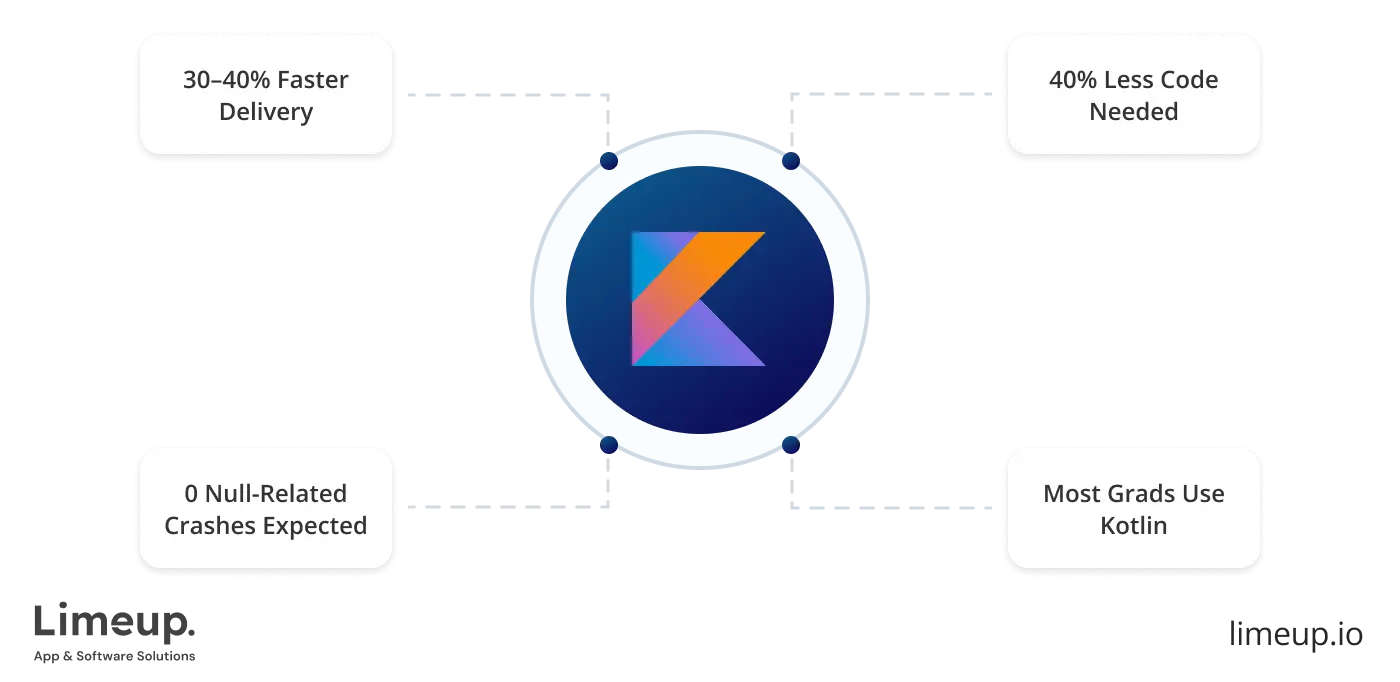
What your business will benefit from is that your programmers will be applying less code to get the same jobs done. For example, a Java feature that would require 50 lines will only need about 30 in Kotlin. The use of less code means that there will be less chance of bugs and also that the code will be reviewed faster during the pull requests.
It is very probable that your application will not crash so often since Kotlin prevents the occurrence of unexpected null-related failures by imposing explicit nullability rules. On the other hand, null checks in Java codebases rely entirely on the developers’ discipline, resulting in more NPEs.
On the other hand, Kotlin compels programmers to treat these situations beforehand and to thus avoid unhandled exceptions that might otherwise go unnoticed until production.
The developers’ productivity boosts significantly and it is noticeable. Some teams report up to 30–40% faster delivery after migrating to Kotlin, likely due to reduced boilerplate and fewer bugs.
Kotlin can make it easier for developers to work on the main business logic by reducing boilerplate and simplifying repetitive tasks. For example, if a team incurs an annual cost of $150,000, even a slight boost in productivity could result in huge value addition through the conversion of the cost into sales.
Similarly, hiring becomes an easier task. Today, new computer science graduates are taught Kotlin in their university courses. As a result of the language’s modern syntax, it attracts talent who would avoid Java’s verbose forms and instead opt for Swift or TypeScript.
What is Java?
Java is a well-known programming language that is the basis of Android, enterprise back-ends, and a great number of business systems all over the world. It is developed and maintained by Oracle and the open-source community. LinkedIn, eBay, and most Fortune 500 companies depend on Java for critical infrastructure.
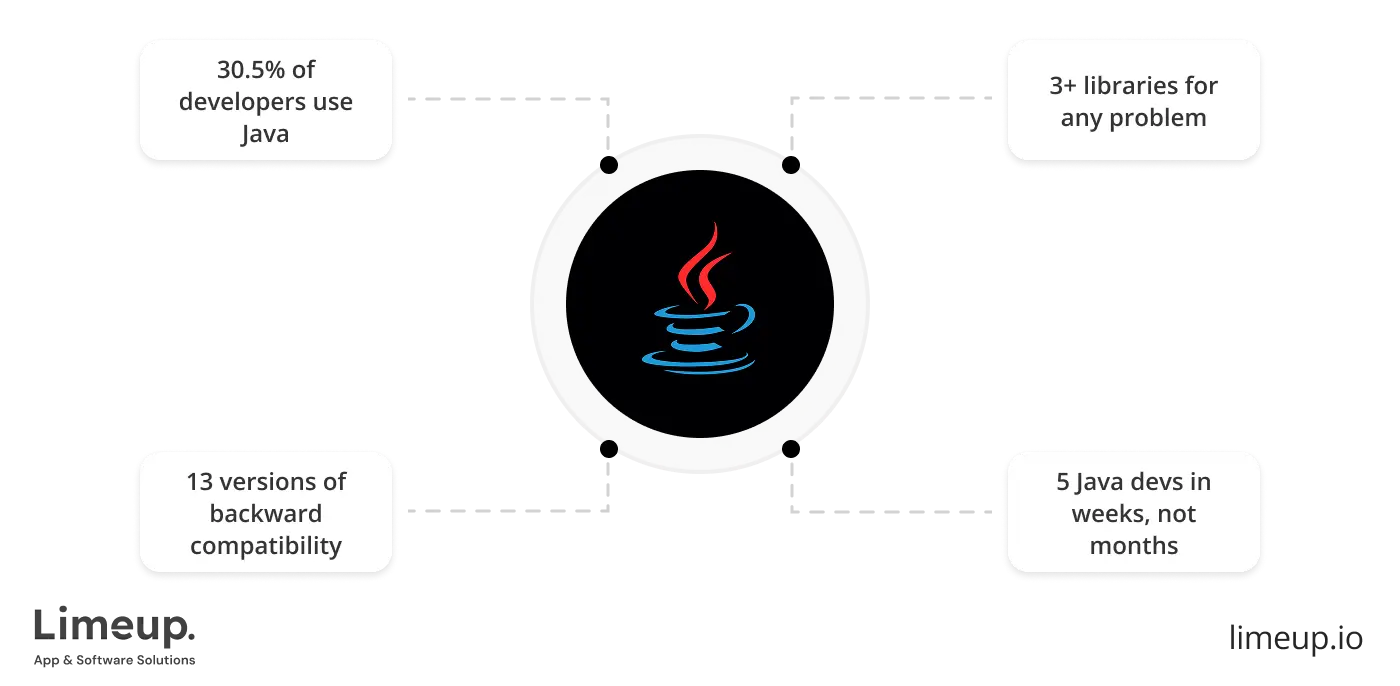
As per the Stack Overflow Developer Survey, nearly 30.5% of the professional developers claimed to have utilized Java during the year preceding, thus showcasing the popularity of the language.
The main benefit: current staff of almost every app development company in the UK and other countries is familiar with it already. If you have Java developers, they will keep on working without retraining your existing codebase, tools, and deployment pipelines will all work without changes.
Java provides unmatched library access. There are at least three Java libraries available for each problem and all of them have been used in production and are well tested.
Do you need to process payments, connect to obscure databases, or integrate with legacy systems? Java libraries are available and they come with documentation and even Stack Overflow answers that are almost 15 years old.
The talent pool is enormous. Hiring is quick, contractors are plenty, and sometimes in the markets where Kotlin specialists are, Java developers’ salaries are lower. If you need to speedily scale up that project, then in weeks you will have five experienced Java developers instead of months.
Long-term support is one of the factors that ensures the stability of a programming language. Java versions absolutely guarantee downward compatibility. A piece of Java 8 code would still be working in Java 21 without any changes. For the companies that demand 10-year maintenance cycles, this predictability is a risk reducer.
On the downside, though, Java has the drawback of needing more lines of code to complete a task. Developers have to code getters, setters, and null checks repeatedly. The code length affects the speed of development and it also attracts bugs.
Additionally, some teams might have to take extra time in code reviews to catch the errors that the Kotlin compiler would have prevented automatically.
Kotlin vs Java: key differences explained
The decision on whether to go with Kotlin or Java in 2026 is based on priorities such as performance, team velocity, long-term sustainability, and the extent of modernization that your product roadmap necessitates.
Each programming language has its unique areas of strength. Knowing Kotlin vs Java differences enables your team to prevent surprises during the development process.
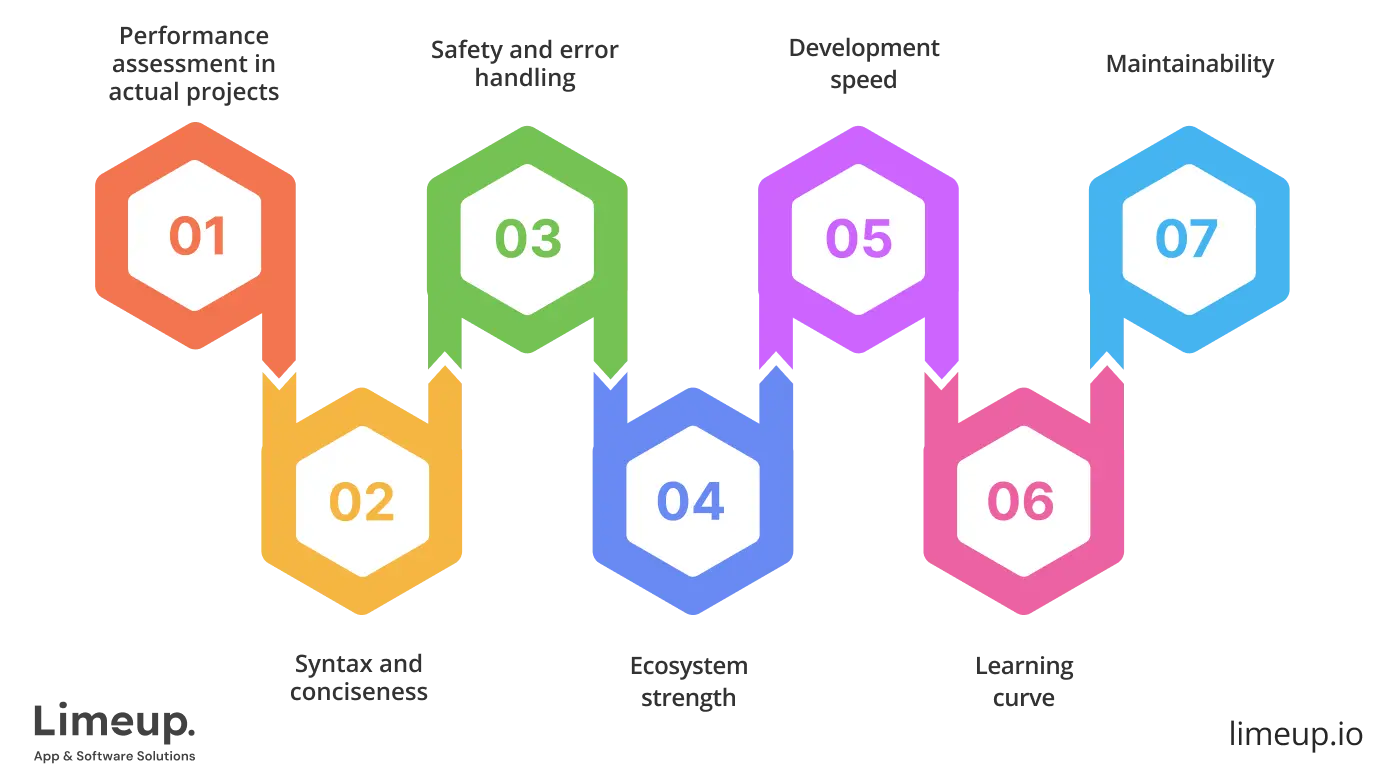
Performance assessment in actual projects
Due to the fact that both languages are executed on the JVM, the raw performance is usually perceived as nearly equal. However, Java has always been considered the fastest language thanks to the constant improvement of the JVM over decades.
This has been a long-term advantage in high-load enterprise systems such as banking engines, telecom services, and logistics platforms, where Java’s predictability still prevails.
On the other hand, Kotlin is catching up by means of its efficient bytecode generation, the use of coroutines which consume less power, and so on. In fact, complex Android UIs and reactive back-ends often experience better performance if implemented in Kotlin due to its concurrency model that prevents thread explosion.
The developers who are migrating their microservices to Kotlin often report lower CPU usage during peak hours along with better asyncio flows. This is a performance-driven Kotlin vs Java comparison:
| Factor | Kotlin | Java |
| Async handling | Coroutines (lightweight, scalable) | Threads & executors (heavier) |
| Startup time | Comparable, slightly faster in coroutine-heavy apps | Consistent, mature |
| Memory usage | Often lower for async tasks | Stable, predictable |
| Best use cases | Android UI, microservices, async-heavy systems | Large enterprise platforms, batch processing |
Syntax and conciseness
The Kotlin syntax has an undeniable advantage over Java in terms of reducing code quantity for the usual business applications by a great margin. Continuous getters, setters and verbose API calls bottleneck Java developers, whereas Kotlin ones enjoy the opposite liberating experience.
Take for instance a data model with three fields, constructors, and standard methods, in which 47 lines of Java are required as opposed to just 1 line of Kotlin. It is a common observation that Kotlin leads to shorter code review sessions since the reviewers can handle less code.
Java has added modern features such as var (local variable type inference since Java 10), switch expressions (Java 14), and pattern matching (Java 16+). These enhancements decrease the verbosity gap but do not completely remove it.
Old codebases still contain a lot of boilerplate that can’t be automatically converted to the newer syntax without going through a long process of refactoring. From day one, Kotlin’s expressiveness has meant that developers spend their mental energy on business logic rather than on ceremony code.
| Metric | Kotlin | Java |
| Lines of code (same app) | 45,000 | 68,000 |
| Data model classes (avg) | 3-5 lines each | 40-50 lines each |
| Null check verbosity | Built-in operators | Manual if-statements |
| Collection operations | 1-2 lines with stdlib | 3-5 lines or Stream API |
Safety and error handling
Kotlin considers safety to be a very important matter. The question of nullability is the foundation of the type system; as a result, the dreaded NullPointerException is barely seen. Google’s crash analytics reveal that NullPointerExceptions are responsible for more than 70% of the crashes of Android apps in Java.
Automatic casting, sealed classes and safe collection handling are some of the features that the language offers to help reduce runtime errors and thereby increase safety.
Java is continually improving its error-handling strategy, but at the same time, null is always a threat because the language was designed long before these patterns became standard.
Java permits any reference to be null by default, thus, requiring developers to keep manual checks in their minds and throughout the entire codebase. The Optional class in Java 8 is a relief, but it is still optional rather than mandatory.
Java’s environment promotes strictness in handling, but Kotlin makes it a rule by the compiler. This way, entire classes of bugs can be eliminated and the duration of debugging can be significantly reduced.
| Safety Feature | Kotlin | Java |
| Null safety | Enforced at compile time | Runtime crashes possible |
| Null handling | Built-in safe operators | Manual checks or Optional class |
| Checked exceptions | Not required | Required try-catch blocks |
| Type casting | Automatic after verification | Manual casting needed |
| Variable immutability | Clear val and var distinction | Final keyword often forgotten |
| Sealed classes | Exhaustive pattern matching | Limited enum or inheritance |
| Crash reduction | 40-60% fewer null crashes reported | Baseline |
Ecosystem strength
The ecosystem surrounding Java is huge and includes frameworks, libraries, tools, and community expertise. Spring, Hibernate, Maven, and Gradle are among the major players in enterprise development. Large organizations with old legacy systems depend quite a bit on the tools that are Java-supported.
Kotlin already communicates with the same ecosystem without any problem and as a result of that, it is getting benefits instantaneously. At the same time, Kotlin-specific tools such as Kotlin Multiplatform, kotlinx.coroutines, Ktor, etc. are getting stronger day by day.
Android Studio is completely compatible with Kotlin, and backend frameworks are gradually providing it with first-class integration. Here is a quick view:
| Factor | Kotlin | Java |
| Library ecosystem | Built on JVM + growing Kotlin-first libraries | Massive, legacy-friendly |
| Android support | Officially preferred | Supported, less modern |
| Backend tooling | Ktor, Spring support, Multiplatform logic | Spring, Quarkus, Micronaut |
| Community | Expanding quickly | Deep, long-established |
Development speed
The development process is accelerated thanks to Kotlin’s brief syntax, built-in coroutines, and robust standard libraries. Developers coming over from Java usually contribute new functionalities and are less over-the-wall on troubleshooting with smoother communication. The use of fewer lines of code and more systematic organization leads to shorter sprints.
On comparing Kotlin vs Java performance in development velocity, Java performance highly depends on the skill level and syntactic sugar of the frameworks being used.
Kotlin is reported by the teams to have doctors in cleaning up PRs and mastering refactoring rounds as the language gives them less room to make mistakes.
| Factor | Kotlin | Java |
| Code volume | Low | Higher |
| Async implementation | Simple, lightweight | Verbose, complex |
| Typical sprint speed | Faster for new features | Stable, slower for UI-heavy/async tasks |
Learning curve
Java still wins the race concerning beginner programmers because of its simple, classical approach. It is a common language in college courses, so junior programmers who come into the industry often count on its use already knowing the basic patterns.
Kotlin’s change of mind: functional constructs, type inference, extension functions. Developers switching from Java will make a rapid transition, however, because of the similarities between Java and Kotlin, the former is brighter. It takes longer for teams bringing engineers from non-JVM environments to get over the learning curve, but it eventually pays off in terms of code cleanliness.
| Factor | Kotlin | Java |
| Entry difficulty | Moderate | Lower |
| Learning time for Java devs | 1-2 weeks | Immediate |
| Documentation | Strong | Extensive |
Maintainability
Fewer lines of code are one of the results of Kotlin’s succinctness, which also leads to small and clear codebases. Strong types and immutability patterns are the main causes behind reduced nasty regressions.
The teams that deal with the long-run maintenance of Android, or microservice ecosystems, have fewer surprises and are less troubled by a difficult refactoring session.
Java codebases reveal structure and predictability in their entirety. Legacy systems that have large teams for support often go with Java as the conventions by which they were built are now validated for decades. Maintainability is still a significant factor, albeit it can only be strong if more code and stricter discipline are applied to prevent complexity.
| Factor | Kotlin | Java |
| Codebase size | Smaller | Larger |
| Refactoring ease | High | Moderate |
| Long-term stability | Excellent | Enterprise-proven |
While Java offers long-term stability and a vast ecosystem that keeps enterprise systems operating like clockwork, Kotlin offers current language capabilities, more seamless async handling, and quicker development cycles.
The technical side of the project, methods of hiring, and willingness to modernize, are all factors that influence the choice of either Java or Kotlin. Each language has its area of excellence and hence, the decision becomes simpler with unambiguous priorities.
Kotlin or Java: which language to choose for your project?
The decision should be rooted in the engineering structure, product roadmap, and delivery timelines of your company. The two languages are just better in different conditions, and the best way for the business to benefit in the long run is to recognize and accompany these strengths with its priorities.
What follows is a structured approach that will allow you to make a confident and practical choice.
When does Kotlin become the better fit?
For speed, reliability, and scalability, the question “Is Kotlin better than Java?” often tilts toward Kotlin for modern development needs. It makes the writing of code less time-consuming and upping the productivity of the developer team becomes a free and easy task with the help of its modern tools.
Before you hire Kotlin developers for your project, consider these cases when adoption of Kotlin makes the most business sense.
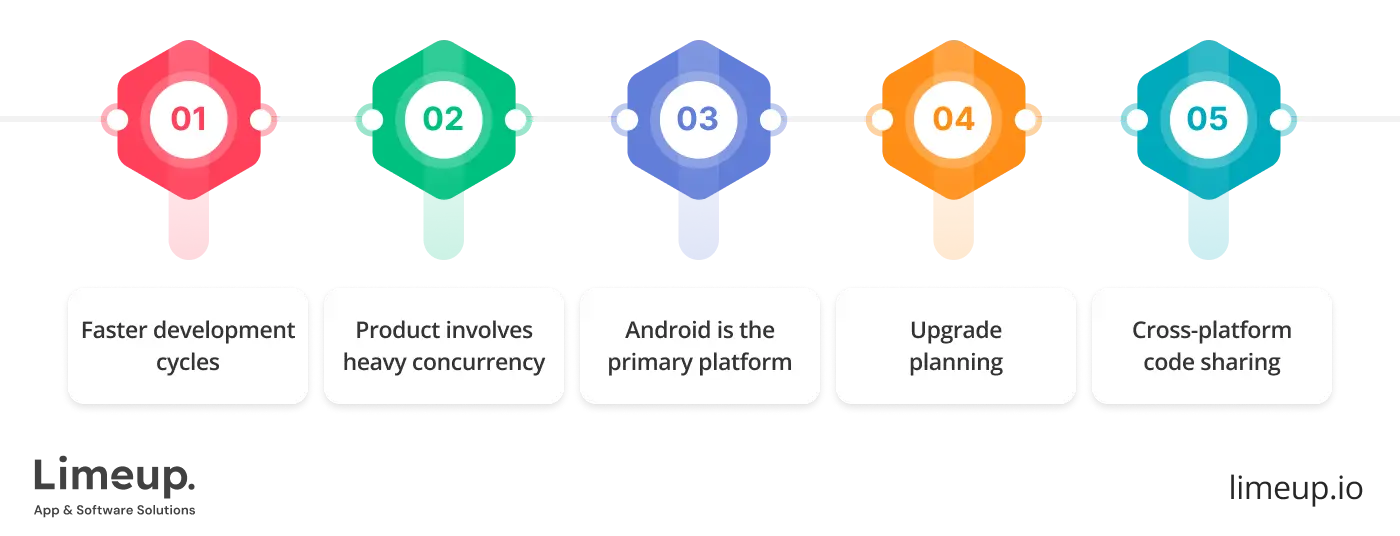
- You want faster development cycles.
Kotlin gets rid of the duplicate code and streamlines the processes in a way that programmers have to work on the same task for less time. Shortened sprints and reduced bugs advance your roadmap without adding engineering resources’ stress.
- Your product involves heavy concurrency.
Kotlin coroutines take care of asynchronous tasks in an efficient way. Applications that are processing real-time conversations, financial updates, or large data streams feel less hectic and more stable.
- Android is your primary platform.
The first choice of Google’s Kotlin means moving in the right direction together with the latest tools and operating system features. Teams do not have to wait because of compatibility issues and the updates are delivered to the market more quickly.
- You plan a modernisation journey.
With the help of interoperability, the team can gradually replace the existing Java modules with the new ones. The new features continue to be released while the older parts are being refurbished behind the scenes.
- You explore code sharing across platforms.
Kotlin Multiplatform allows for the use of common logic for Android, iOS, desktop, and web. Its reliability by 2026 will certainly offer a good way to lessen the duplication of the development work done.
When does Java offer more advantages?
Java shines in environments that demand robustness, team scalability, and extensive tooling support. Is Kotlin similar to Java in these aspects? While both run on the JVM, Java’s decades of maturity provide distinct advantages here. Organizations with established infrastructure or high compliance requirements find Java hard to beat.
The ability to hire Java developers quickly and cost-effectively makes it ideal for projects requiring rapid team scaling. Typical cases where it excels include:
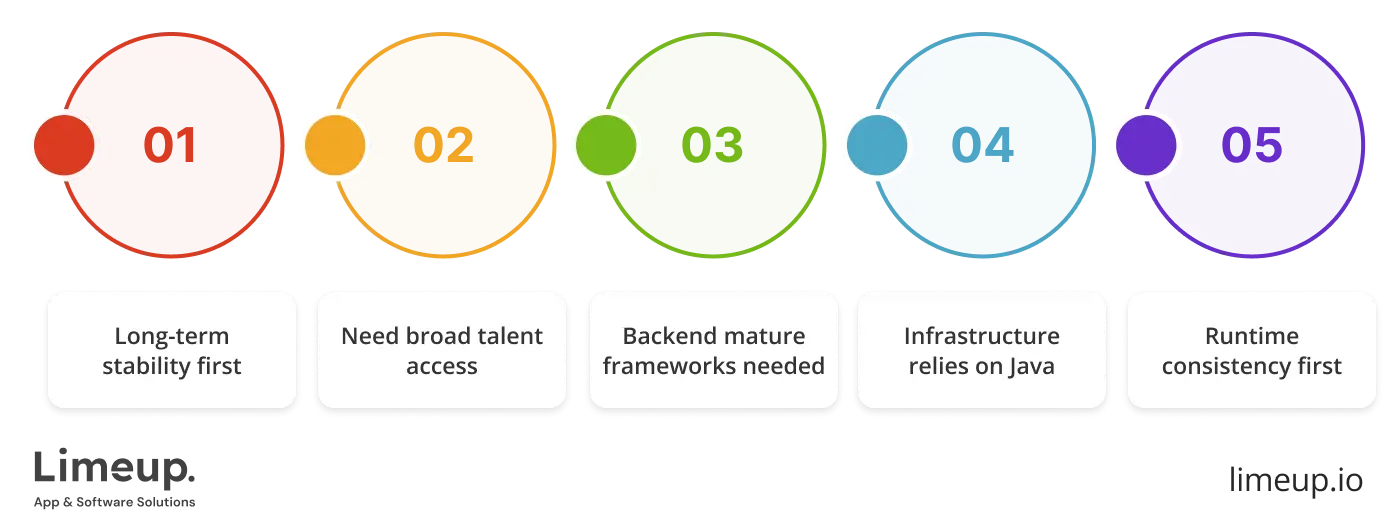
- Your organisation prioritises long-term stability.
Java provides predictable behaviour under load and has decades of real-world tuning. Enterprise teams rely on it for mission-critical systems that cannot afford surprises.
- You need access to a large talent pool.
Java developers remain abundant worldwide. Expanding teams quickly becomes realistic, supporting aggressive delivery goals.
- Your backend requires mature frameworks.
Spring, Micronaut, and other Java ecosystems handle extensive integrations and high data throughput. Large-scale backend environments benefit from this maturity.
- Your infrastructure already depends on Java.
Rewriting established systems introduces unnecessary risk. Sticking with Java keeps architecture unified, pipelines stable, and compliance simpler.
- You value runtime consistency above all.
JVM optimisations ensure high performance across long product lifecycles. Enterprise support and broad tooling safeguard reliability.
In reviewing numerous projects, we found that the differences between Kotlin and Java become most apparent in specific use cases.
Kotlin truly shines when rapid delivery, clean code, and cross-platform logic are key priorities. At the same time, our experience confirmed that Java continues to dominate in environments where stability, mature frameworks, and long-term reliability matter most.
Kotlin and Java: core similarities
When choosing a programming language for JVM-based projects, understanding what Kotlin and Java share can help you make a smarter decision. Both languages bring decades of proven reliability, extensive ecosystems, and powerful tooling, which means your Android programmers can leverage familiar practices while still benefiting from modern innovations.
JVM compatibility
Both Kotlin and Java run on the Java Virtual Machine, ensuring seamless interoperability. Difference between Java and Kotlin needs to be understood as the main reason for the difference between them; still, their very different syntax and features do not prevent them from compiling to the same bytecode.
We’ve found that in projects where mixed codebases exist, Kotlin modules can integrate directly with Java libraries without special wrappers or complicated migration steps. This compatibility allows teams to modernize incrementally, maintain legacy systems, and introduce new features without disrupting production.
| Feature | Kotlin | Java |
| JVM runtime | ✅ Fully compatible | ✅ Native |
| Interoperability | ✅ Can call Java code directly | ✅ Can call Java code natively |
| Legacy integration | ✅ Smooth migration | ✅ Full support |
Cross-platform capabilities
Both languages support cross-platform development to a notable extent. Kotlin offers Multiplatform, which allows sharing business logic between Android, iOS, web, and desktop apps. Java, although traditionally linked to the JVM, now also supports server-side applications, mobile apps, and some GUI frameworks.
However, in reality, there are still cases where companies are sharing main logic in Kotlin across different platforms, but using Java for the back-end quite often, thus forming the mix-type ecosystems that take the best of both worlds by not losing enterprise-grade stability and at the same time, getting the complete range of Kotlin advantages over Java.
| Feature | Kotlin | Java |
| Shared logic | ✅ Android, iOS, web, desktop | ✅ JVM-based backend & desktop |
| Mobile support | ✅ First-class Android support | ✅ Android via legacy libraries |
| Backend support | ✅ Ktor, Spring, Micronaut | ✅ Spring, Quarkus, Micronaut |
Tools and IDE support
Both Kotlin and Java enjoy strong development tools and IDE support. IntelliJ IDEA, Android Studio, Eclipse, and VS Code offer excellent debugging, refactoring, and code completion for both languages. In our experience, teams switching between these languages rarely face tooling gaps.
Kotlin benefits from modern IDE features like inline suggestions and coroutine debugging, while Java provides mature profiling and enterprise-grade debugging tools.
| Feature | Kotlin | Java |
| IDE support | ✅ IntelliJ IDEA, Eclipse | ✅ IntelliJ IDEA, Eclipse |
| Debugging tools | ✅ Advanced coroutine & JVM debugging | ✅ Mature, stable JVM debugging |
| Build systems | ✅ Gradle, Maven | ✅ Gradle, Maven |
The key takeaway from our projects is that Kotlin and Java overlap significantly in runtime, cross-platform reach, and tooling. Choosing between them often comes down to language features, team experience, and long-term maintainability rather than fundamental capabilities. Both deliver reliable, enterprise-ready results.
Popularity and market trends in 2026
The developer landscape in 2026 clearly reveals the evolution of JVM-based languages. When evaluating Kotlin versus Java, Kotlin has been gradually adopted for Android and cross-platform development. It primarily owes its adoption to its concise syntax, modern safety features, and Google’s ongoing support.
Enterprises migrating legacy Java systems often bring in Kotlin piece by piece, thus enjoying the increased developer productivity without being a disruption to their already ongoing operations.
Java is still the king of the mountain when it comes to large-scale enterprise and backend systems. The language has been around for decades and that has continued to be a huge advantage in terms of talent, libraries, mature frameworks, and hence being the choice for projects that value stability and long-term maintainability the most.

- Mobile and cross-platform trends
The emergence of Kotlin is especially strong in the arena of mobile as well as multiplatform development. The Kotlin Multiplatform allows one to share the same business logic across platforms such as Android, iOS, web and desktop apps thus reducing the duplicated work and speeding up the process of getting the product to the market.
Companies such as Philips, Cash App, and Quizlet have used Kotlin to unify development workflows across multiple platforms and gain practical advantages in performance, maintainability, and code safety.
- Enterprise adoption and back-end systems
Java is still very much alive and deeply rooted in enterprise back-ends, financial systems and large-scale microservices architecture. Its stability, backward compatibility and ecosystem strength make it indispensable in those industries where the cost of downtimes or errors is very high.
Even as Kotlin continues to gain popularity, Java’s market share is not much affected as a result of its perceived reliability and the enormous number of legacy systems still in existence.
- Talent and hiring trends
By 2026, the Kotlin talent pool will have expanded significantly, driven by university curricula and developer interest in modern JVM languages. Java, however, still boasts millions of active developers worldwide, ensuring rapid team scaling and access to experienced engineers.
Teams adopting Kotlin can benefit from its growing popularity while Java ensures predictable hiring timelines and minimal ramp-up challenges.
Overall, Kotlin is increasingly favored for new mobile projects, multiplatform initiatives, and modernization efforts, while Java maintains a stronghold in enterprise back-ends, large-scale infrastructures, and long-term system maintenance.
The choice between Kotlin and Java development company services depends less on raw popularity and more on aligning market trends with project goals and available resources.
Conclusion
Java vs Kotlin both offer different strengths in the development of Android and JVM-based applications. The guide that was provided helped us in examining their basic differences, such as how they handle concurrency, how much they differ in syntax, tooling, and maintainability, and pinpointing the conditions under which one is superior to the other.
Our practical analysis based on real projects illustrates the extent to which the choice of language can influence the factors of speed, reliability, and scalability. If you want to be sure that the right language for optimal results is picked for your next project, contact Limeup, and we will assist you in turning your requirements into a practical high-performing solution.
FAQ
Is Kotlin faster than Java in real-world applications?
The performance of Kotlin and Java on the JVM is pretty much the same in most real-world cases. Java has a tiny advantage in speed for some backend-heavy tasks because of the optimizations made over the years, while on the other hand, Kotlin’s coroutines and modern concurrency features have made Android apps and async-heavy systems run more efficiently and thus improve responsiveness.
Which language is better for Android development in 2026?
For new Android projects, Kotlin is the language of choice. Google’s complete backing together with its clean code that is less prone to errors and easier to debug are all the reasons for speeding up development and delivery of new features. Maintaining legacy apps using Java is also still an option, but Kotlin holds an upper hand in respect to future-oriented Android apps.
Can Kotlin fully replace Java in modern projects?
Kotlin turns out to be pretty capable and can take over almost all the tasks that Java does, particularly in mobile apps, server-side and cross-platform development. Nevertheless, Java will still be a practical choice in very mature enterprise back-ends where there are extensive Java libraries and long-term maintenance requirements.
Which language has better performance on the JVM?
The Java language is more suitable for high-load environments, enterprise systems, and places with mature threading models, whereas the use of coroutines in Kotlin provides lightweight concurrency that will most likely improve the performance of asynchronous or UI-heavy applications.
Is Kotlin more expensive to use in terms of development resources?
Kotlin development costs are similar to Java, but there are nuances. Hiring Kotlin specialists can be slightly more expensive in some markets due to its newer ecosystem. On the flip side, reduced boilerplate code, fewer bugs, and faster feature delivery can offset higher salaries, often resulting in comparable or even lower overall project costs.